

A corporate taxi account can make business travel easier by bringing repeat journeys into one organised arrangement, rather than simply changing how they’re billed. Coordinating staff transfers, executive journeys and regular bookings takes time, particularly when people travel to different places on different schedules. A clear account arrangement can make those recurring transport needs simpler to plan and administer.
For businesses around Camberley and Farnborough, Euro Taxis provides corporate account work and business travel, with streamlined account billing options. This guide explains how a corporate taxi account can support regular journeys, when it may suit your organisation and which business trips it can cover. It also sets out practical details to consider, from the routes your team uses to how you coordinate transport administration.
Key Takeaways
- A corporate taxi account can help organise repeat business journeys and reduce the effort of coordinating separate bookings.
- Consider how often staff, clients or executives travel before deciding whether account-based travel suits your organisation.
- Business journeys may include executive travel, staff transfers, airport transfers and ferry-port pick-ups or drop-offs.
- Mapping regular routes around Camberley and Farnborough helps clarify the transport support your team needs.
- Euro Taxis supports local business travel with corporate account work and streamlined account billing options.
What is a corporate taxi account, and when does a business need one?
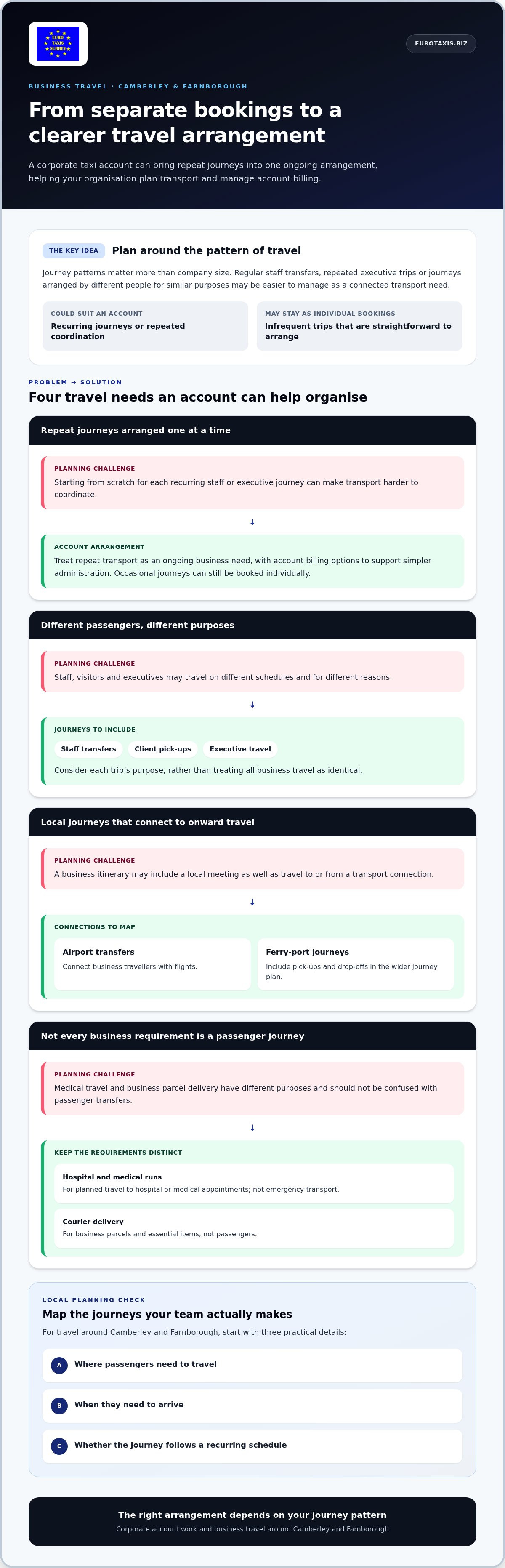
A corporate taxi account is an ongoing business arrangement for organising taxi journeys, rather than treating every trip as a separate personal booking. It brings repeat transport needs into one working relationship and can support simpler administration through account billing options. Journeys may vary: one week could involve a staff transfer, another an executive journey or a client pick-up.
Whether an account is useful depends on your pattern of travel. A business arranging regular journeys may find it easier to manage transport through a consistent arrangement than by starting from scratch for each trip. For an overview of how work-related journeys fit into wider travel planning, see this Business Travel Overview.
How does a business taxi account differ from booking one journey?
A one-off booking covers a single journey. An account is an ongoing arrangement for a business’s transport needs, which can make repeat travel easier to plan and manage. For example, if staff regularly travel between a workplace and a meeting location, the business can treat those journeys as a recurring requirement instead of organising each one in isolation.
That doesn’t mean every booking has to follow the same pattern. It means the organisation can consider recurring travel as a connected need, even when journeys involve different staff members, destinations or business purposes. Occasional trips can still be arranged individually.
Which businesses may benefit from an account?
Journey patterns matter more than company size. A small organisation with regular staff transfers may have more reason to consider an account than a larger business that arranges only occasional taxi journeys. The same applies to firms coordinating executive or client travel alongside routine staff transport.
- Note recurring journeys, such as staff travel between sites or regular executive trips.
- Consider whether different people in your organisation arrange transport for similar purposes.
- Include travel across Camberley and Farnborough if your business operates or meets clients in both areas.
If your list includes recurring journeys, multiple travellers or repeated coordination, a corporate taxi account may be worth considering. If trips are infrequent and straightforward to arrange one at a time, separate bookings may remain practical. There’s no fixed company-size threshold: consider whether an ongoing arrangement would make transport easier to organise and administration clearer for your business.
Which business journeys can a corporate taxi account support?
Business travel can involve many types of journey. A working day might include a staff transfer between locations, an executive travelling to a meeting or a visitor arriving for an appointment. Euro Taxis provides business travel and account work for organisations around Camberley and Farnborough, supporting journeys planned around each trip’s purpose.
Thinking in journey types helps you identify what your travel arrangements need to cover. For wider context on business travel, the U.S. Travel Association’s Business Travel Industry Trends offers industry forecasts. For local planning, start with practical details: where passengers need to travel, when they need to arrive and whether the journey follows a recurring schedule.
Staff, client and executive journeys
Staff transfers can support employees travelling between work locations or to business meetings. Client journeys may involve collecting a visitor and taking them to a meeting, while executive travel can fit around a busy diary. Needs vary throughout the day, so consider each trip’s purpose rather than treating all business travel as identical.
For example, a business active in both Farnborough and Camberley might arrange local staff travel on some days and transport for a visiting client on another. Regular corporate journeys can sit alongside less frequent trips. A corporate taxi account lets an organisation consider these different requirements as part of its wider transport arrangement, rather than focusing on one journey at a time.
Airport transfers, medical runs and courier deliveries
Some business itineraries begin or end further afield. Airport transfers connect business travellers with flights, while ferry-port pick-ups and drop-offs can form part of a wider journey plan. Include these alongside local travel when mapping an itinerary, particularly if a trip combines a meeting in the area with onward travel.
Hospital and medical runs are another service offered by Euro Taxis. They support planned travel to hospital or medical appointments and are not emergency transport. Courier delivery is different again: it is for business parcels and essential items, not passengers. Keeping these categories separate helps your business identify the right arrangement for each need.
- Passenger journeys: staff transfers, client travel and executive journeys.
- Travel connections: airport transfers and ferry-port pick-ups or drop-offs.
- Other requirements: hospital and medical runs, plus courier delivery for business items.
Reviewing these needs together gives your organisation a clearer picture of its transport requirements across Camberley and Farnborough. Read more about Euro Taxis business travel.
Corporate taxi account or individual bookings: which approach fits?
There isn’t one right arrangement for every business. Consider whether your journeys are occasional and unrelated, or recurring enough that planning and administration could benefit from a consistent approach. A corporate taxi account isn’t only for organisations with a high volume of travel. The pattern and coordination involved matter as much as the number of trips.
- Journey frequency: Individual bookings may suit occasional, separate trips, while an ongoing account arrangement may suit repeat staff travel or regular business journeys.
- Coordination effort: Individual bookings are arranged separately. A continuing arrangement can help organise recurring requirements more consistently.
- Administration: Separate trips are handled one by one. Streamlined account billing options can support simpler transport administration through an ongoing arrangement.
This comparison is a guide, not a rule. A business could use individual bookings for occasional travel and consider an account if a recurring need develops. Neither approach is automatically cheaper or more convenient. The right fit depends on how your organisation arranges and manages its journeys.
When are individual taxi bookings enough?
Separate bookings may be practical when journeys are infrequent, unrelated and straightforward to organise as they arise. For instance, a business arranging a one-off meeting trip may not need an ongoing arrangement if there are few similar journeys to coordinate. With less repeat travel, there may also be less need for a consistent way to manage transport administration. The decision can reflect the scale and pattern of your current requirements.
When can an ongoing account arrangement help?
An account may be worth considering when staff transfers, executive journeys or other business travel recur. A consistent arrangement gives the organisation a way to consider those requirements together, rather than treating each repeat need as entirely separate. Euro Taxis offers streamlined account billing options to help make transport administration clearer.
Consider the work involved as well as the journey count. If several people arrange repeat travel, or the same kinds of journeys need organising regularly, an ongoing arrangement may offer a useful structure. A modest but predictable travel requirement can still be worth reviewing. If trips are rare and easy to handle individually, separate bookings may remain a sensible fit.
To compare the options, note how often travel occurs, who coordinates it and how your organisation currently tracks transport administration. These points help you weigh a corporate taxi account against individual bookings on practical grounds, rather than choosing based on company size alone.
How to assess your corporate travel needs in Camberley and Farnborough
A clear picture of your regular journeys makes it easier to judge whether a corporate taxi account fits your organisation. Start with how people and business items need to move, then note the locations, timing and coordination involved. The aim is to understand your travel pattern before discussing arrangements.
- Group journeys by purpose. Separate staff transfers, executive travel, client meetings and airport trips so each requirement is easy to identify.
- Map the locations. Record where journeys begin and end in Camberley and Farnborough, including connections between workplaces, meetings and onward travel.
- Mark recurring and occasional needs. Distinguish regular journeys from one-off requests to identify which requirements may benefit from a consistent arrangement.
- Note practical details. Record typical passenger numbers, important arrival times and relevant instructions for each journey type.
Map the journeys your organisation arranges most often
Use a simple list or table to record each journey’s purpose, start and end points, and whether it repeats. For example, list staff travel between business locations separately from an executive meeting journey or client visit. Include Camberley and Farnborough origins and destinations where relevant, rather than grouping every trip under a broad heading such as “business travel”.
Then mark each journey as recurring or occasional. Writing down repeated routes makes regular requirements easier to spot, while keeping one-off needs visible without mistaking them for a pattern.
Set out passenger, timing and coordination needs
For each recurring journey, record the typical number of passengers and any relevant travel instructions. Note when passengers need to arrive, whether the timing follows a regular pattern and whether the journey relates to a meeting, staff movement or onward travel. Keep the information practical and concise. The aim is to describe the need clearly, not create a detailed operating procedure.
Identify who in your organisation arranges journeys and tracks transport administration. If responsibility is shared, note how colleagues coordinate the details so the arrangement reflects the way your business works.
- Journey: purpose, origin, destination and whether it recurs.
- Passenger needs: typical numbers and relevant instructions.
- Timing: important arrival times and any regular schedule.
- Coordination: the person or team arranging travel and handling its administration.
With this outline prepared, you can describe your organisation’s local business travel needs clearly. Read about corporate travel arrangements with Euro Taxis.
A Euro Taxis corporate account for business travel around Camberley and Farnborough
For organisations arranging business transport in Camberley and Farnborough, Euro Taxis provides corporate account work and business travel. The arrangement can support a mix of staff transfers, executive journeys and regular corporate travel, with streamlined account billing options to help simplify transport administration. The aim is to bring your business travel requirements into a clear arrangement that reflects how your team travels.
Business journeys with Euro Taxis
Business travel can involve different people and purposes throughout the working week. Staff may need transport for work-related journeys, executives may travel to meetings, and regular corporate journeys may follow a familiar pattern. Euro Taxis supports these needs around Camberley and Farnborough, as well as wider travel requirements such as airport transfers and ferry-port pick-ups or drop-offs.
Considering journeys together helps your organisation describe what it needs. A regular staff transfer may call for a different arrangement from an executive trip or airport journey. Account billing options are another practical consideration, without requiring every trip to be identical.
- Staff travel: transfers connected with your organisation’s regular transport needs.
- Executive journeys: business travel for meetings and other work commitments.
- Wider itineraries: airport transfers and ferry-port journeys as part of business travel planning.
Discuss a corporate taxi account with Euro Taxis
A useful starting point is a straightforward outline of your organisation’s travel: journey types, locations, recurring requirements and how transport is currently coordinated. Include relevant passenger or timing needs, along with the administration your team wants to simplify. This gives a practical picture of how a corporate taxi account could support your business travel around Camberley and Farnborough.
You don’t need a complicated plan. A clear summary of regular requirements and occasional business journeys can show where a continuing arrangement may fit and how account billing options relate to the transport you arrange.
Euro Taxis brings corporate account work together with business journeys including staff transfers and executive travel. Explore Euro Taxis business travel for your organisation.
Make your next business travel decision with confidence
Your travel requirements can change as teams, schedules and business priorities shift. Treat your journey outline as a working reference: revisit it when travel patterns change and note which arrangements are becoming recurring. This keeps decisions grounded in what your organisation actually needs, rather than assumptions about how much travel an account should involve.
If a corporate taxi account looks like a sensible fit, share the journey patterns and coordination needs you’ve identified. Euro Taxis provides business travel support for organisations around Camberley and Farnborough, with arrangements that reflect your requirements.
Discuss your corporate travel requirements with Euro Taxis and take a practical next step towards organising your business journeys.
Frequently Asked Questions
What is a corporate taxi account?
A corporate taxi account is a business arrangement for organising taxi travel through an ongoing account relationship. It can help a company manage work journeys as part of its business travel rather than treating each trip as a separate personal expense. For example, a business could use an account arrangement to organise travel for a visiting colleague and manage the associated transport administration.
Is a corporate taxi account suitable for a small business?
Yes. A small business can consider an account if its journey pattern makes an ongoing arrangement useful. Company size alone doesn’t determine the fit. A small team with regular off-site appointments or staff travel may have recurring transport needs, while a larger organisation with only occasional journeys may prefer individual bookings. Review how often travel arises and how much coordination it involves before deciding which approach suits your business.
Can a business taxi account cover staff transfers and executive travel?
Yes, Euro Taxis’ business travel includes staff transfers and executive journeys. These serve different purposes within an organisation: staff may need transport connected with work activities, while an executive journey may relate to a meeting or appointment. Keeping the purpose and passenger details clear helps the business organise each trip appropriately. Regular corporate travel arrangements can support organisations managing a mix of business journey needs.
Can Euro Taxis support business journeys around Camberley and Farnborough?
Yes, Euro Taxis supports businesses arranging travel around Camberley and Farnborough. A local organisation might need to coordinate a journey connected with a meeting, a staff transfer or a visitor’s business itinerary. Sharing the start and end locations, journey purpose and timing gives a clear basis for organising transport. Businesses operating across both towns can include journeys in either location in their travel planning.
Can a corporate taxi account be used for airport transfers?
Yes, Euro Taxis provides airport transfers as part of business travel planning. A company might arrange transport for a staff member travelling to an airport for work or returning after a business trip. Have the journey details and relevant flight itinerary to hand when organising transport. Airport travel can be considered alongside local business journeys as part of the organisation’s wider transport requirements.
How does account billing help businesses manage taxi journeys?
Account billing options can make transport administration more straightforward by bringing business taxi travel into an account arrangement. This gives an organisation a clearer way to consider journeys as part of its business travel, rather than managing each transport requirement in isolation. Euro Taxis offers streamlined account billing options to support this arrangement.
Can a business arrange courier deliveries through Euro Taxis?
Yes, Euro Taxis offers courier delivery for business parcels and essential items. This is separate from passenger journeys such as staff transfers or executive travel. A business might use courier delivery to send an item between work locations or as part of its day-to-day operations. Provide clear collection and delivery details so the requirement is understood as a parcel delivery, not a passenger booking.


