

A child’s special educational needs can affect eligibility for school transport, particularly if they mean the child cannot walk to school. For SEN school transport in Camberley, the local authority considers the child’s needs alongside the relevant distance and school-placement rules. The Department for Education sets the statutory walking distance for a child aged eight or over at more than three miles.
It’s understandable to want a clear idea of how long an application and transport arrangements will take. There is no single waiting time for every case: local authority policies and an assessment of the child’s needs shape the process.
This guide explains when a child may qualify, what to include in an application and how local rules can affect decisions and timings. It also outlines practical next steps if transport is needed, so you can approach the process with a clearer plan.
Key Takeaways
- See how a child’s SEN, mobility needs and school placement can affect eligibility for transport.
- Learn what information to prepare so an application explains the child’s individual travel needs clearly.
- Understand why local authority policies can shape assessment times, transport arrangements and appeal steps.
- Find out which distance rules apply in Surrey and what to consider when planning a school journey.
When is a child with SEN entitled to school transport?
A child may qualify for free transport if special educational needs, disability or mobility needs prevent them from walking to school. Eligibility depends on statutory categories, distance rules and the child’s circumstances.
Council-funded travel eligibility
In England, Schedule 35B of the Education Act 1996 defines categories of children eligible for home-to-school transport, according to UK Parliament. The local authority assesses whether a child meets a category, rather than treating SEN alone as automatic qualification. A parent should focus on how the child’s needs affect travel and access to their school.
For a child with an EHCP, the plan can explain support needs and educational placement. The authority must name the parent’s preferred school unless doing so would represent an inefficient use of resources under section 39(4) of the Children and Families Act. Transport costs can be relevant to that decision, so placement and travel arrangements may need consideration together.
Eligibility categories and distance rules
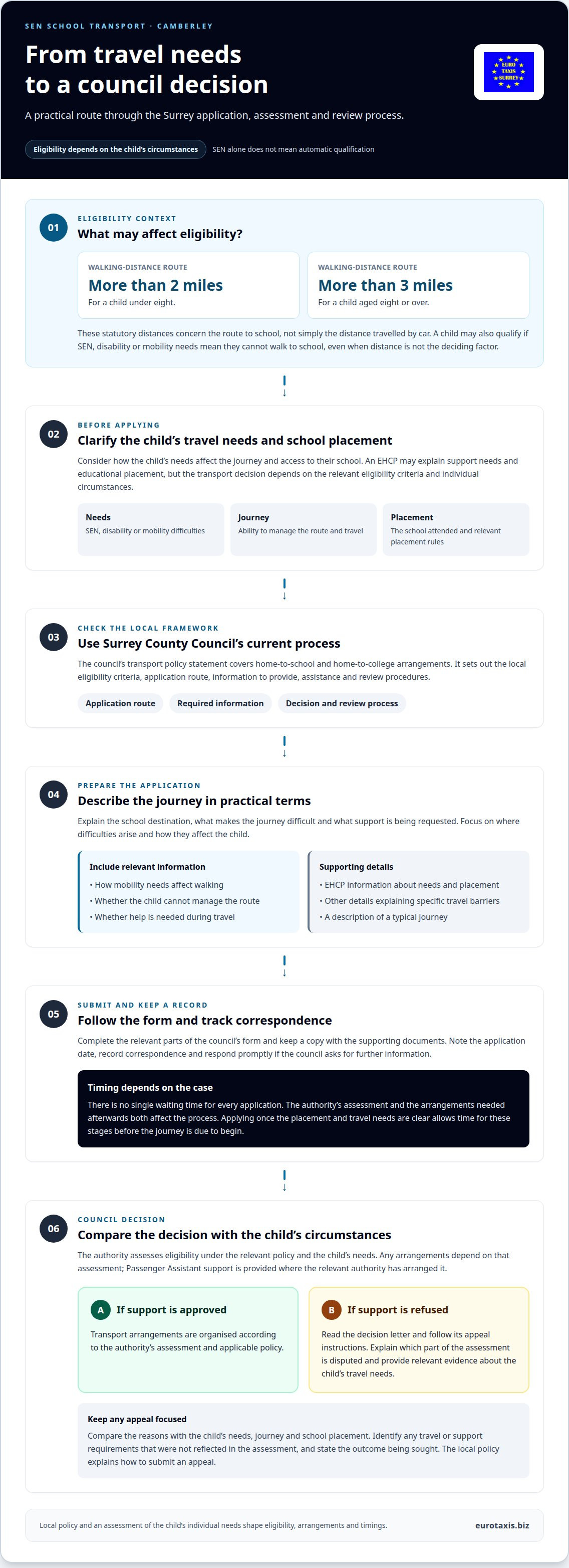
Distance is one route to eligibility. In England, the statutory walking distance is more than two miles for a child under eight, and more than three miles for a child aged eight or over. The Department for Education gives the latter threshold. These rules concern the route to school, not simply the distance travelled by car.
A child may also qualify if SEN, disability or a mobility problem means they cannot walk to school, even when distance is not the deciding factor. The authority considers the child’s ability to manage the journey and the school they attend. For a child without an EHCP, whether the authority arranged attendance at a nearer qualifying school is also relevant.
Give the local authority a clear account of the child’s needs and how they affect the journey. An EHCP may help describe those needs, but the transport decision depends on the relevant eligibility criteria and the child’s circumstances. If support is refused, parents can use the authority’s appeal process.
College travel follows different rules for young people of sixth-form age. Transport law does not provide the same entitlement to arrangements as it does for children of compulsory school age or adult learners. Check the relevant local authority’s transport policy for the process and available support.
Applying for SEN transport
Application times depend on Surrey County Council’s assessment and the arrangements needed afterwards. Apply as soon as the school placement and your child’s travel needs are clear, allowing time for both stages before the journey is due to begin.
Start with Surrey County Council’s current home-to-school transport application process. The council publishes a transport policy statement covering home-to-school and home-to-college arrangements. Read the relevant policy to find the application route, what information to provide and how the authority will communicate its decision.
Describe the child’s needs in practical terms. Include the school destination and explain how special educational needs, disability or mobility difficulties affect the journey. An EHCP can describe support needs and the educational placement. Other relevant information can explain specific travel barriers, such as being unable to walk the route or needing assistance during the journey.
Complete the relevant parts of the council’s form and explain what support you are requesting. Describe a typical journey, where difficulties arise and how they affect the child. For example, explain whether mobility needs make walking difficult or whether the child needs help managing travel. Keep a copy of the form and supporting documents.
After applying, note the council’s stated assessment process and any requests for further information. Respond promptly and keep a record of correspondence, including the date you applied. This makes it easier to follow progress and refer to the original information if the authority asks for clarification.
If the council refuses support, read the decision letter for its reasons and appeal instructions. Explain which part of the assessment you disagree with and provide relevant evidence about the child’s journey needs. Apply early rather than waiting until term starts, as the council needs time to assess eligibility and organise any approved arrangements.
Local authority policies and application processes
Surrey County Council’s policy sets the local framework for assessing school travel. The Department for Education says every local authority must publish a transport policy statement covering home-to-school and home-to-college arrangements. Read the relevant statement for eligibility criteria, application steps, assistance and review procedures.
For Surrey SEN transport, Passenger Assistant support is provided where the relevant authority has arranged it. Other arrangements depend on the authority’s assessment of the child’s needs and the applicable transport policy. The right arrangement depends on the individual circumstances, so avoid assuming a particular vehicle or support option will apply automatically.
To understand a decision, identify which parts of Surrey’s policy the authority used. Compare its reasons with the child’s needs, journey and school placement. If the decision concerns a preferred school, transport costs can be relevant to whether naming that school would represent an inefficient use of resources under section 39(4) of the Children and Families Act.
How do you appeal or request a review? Parents can appeal a local authority’s transport decision through its appeal process. Follow the instructions in the decision letter, explain which part of the assessment you dispute and provide relevant evidence, such as details of how the child’s needs affect travel.
Keep the appeal focused. Explain, for example, why the recorded travel needs do not reflect the child’s mobility or support requirements. Ask the authority to review the specific decision and state the outcome you are seeking. The local policy explains how to submit an appeal and what happens next.
A deadline may apply. A school transport appeal deadline of 20 working days is common among local authorities in England, but Surrey’s published process should guide your appeal. Keep a copy of the submission and note when it was sent. This creates a clear record if the authority asks for further information or issues its review decision.
What distance and eligibility rules apply to SEN school transport in Surrey?
Surrey County Council assesses applications against its transport policy and the child’s circumstances. Distance can be relevant, but a child’s special educational needs, disability or mobility difficulties may also affect eligibility. The key issue is how those needs affect the child’s ability to travel to school.
Journey length has a separate benchmark. Statutory guidance gives a general maximum of 45 minutes each way for a primary-aged child and 75 minutes each way for a secondary-aged child. These are journey-time benchmarks, not automatic eligibility thresholds or guarantees of a particular transport arrangement.
For an individual assessment, describe the child’s needs in practical terms. Explain whether walking is possible, what difficulties arise during travel and what support the child needs. For example, a mobility difficulty may affect whether a child can manage the route, while other needs may affect how they cope with the journey.
Keep journey time and eligibility distinct. A journey within the 45-minute or 75-minute benchmark does not, by itself, establish that a child qualifies. Equally, the assessment must consider the child’s relevant needs, not just the distance shown on a map. Surrey County Council’s policy provides the local framework for the decision.
To prepare for an assessment, describe the journey clearly: the home address, school destination and the child’s difficulties travelling between them. Link each support need to a specific part of the journey, such as walking or managing the trip. This helps show why the child’s circumstances matter alongside distance and journey time.
For planned school travel, discuss school travel arrangements.
Euro Taxis: School contracts
Euro Taxis provides school contracts for organised school travel in Camberley and Farnborough. If a council has assessed eligibility and you need to plan journeys separately, a school contract can provide a practical transport arrangement for the school community. It is separate from a council’s decision about funded SEN transport, so it does not replace an application or appeal.
Schools and organisations coordinating regular travel can discuss their journey requirements and arrangements with Euro Taxis. The company also offers Account Work for ongoing transport needs.
Contact Euro Taxis to discuss school contract arrangements.
Plan the next journey with confidence
Once you understand the school travel decision, plan the journeys around it. Keep the child’s routine and any separate travel needs in view, so arrangements are clear for everyone involved. For families arranging SEN school transport in Camberley, a school contract may suit planned school travel, while other journeys can be arranged separately.
Euro Taxis also offers Hospital/Medicals Runs for appointments and Airport Transfers for airport journeys. These services address different needs from school transport, but can help keep other essential journeys organised. Account Work is available for ongoing transport requirements.
For a practical conversation about your transport needs, contact Euro Taxis about SEN transport. A clear outline of the journey you need is a useful place to begin, and you can take the next step at a pace that works for your family.
Frequently Asked Questions
What if my child is ill?
Where possible, tell the school and the transport contact named in the child’s arrangements before the journey. Explain whether your child will miss the trip or needs a change to the planned collection. Keep the school informed about when they are expected to return. For a medical emergency, contact emergency services; school transport is not an emergency medical service.
What if transport doesn’t arrive?
Keep your child with a responsible adult and contact the school and the transport contact listed in the arrangements. Share the planned collection time, pick-up point and any updates received. If your child is already at school, tell the school that the return journey has not arrived. Follow the school or council’s instructions to keep your child safe while the delay is resolved.
How do I apply for SEN school transport in Camberley, Surrey Heath?
Apply through Surrey County Council, the local authority for Camberley and Surrey Heath. Use its current home-to-school transport application route and explain how your child’s needs affect the school journey. Include the school placement and relevant supporting documents. Keep a copy of your application, then follow the council’s decision and appeal instructions if support is refused.
Which children qualify for home-to-school transport under Surrey County Council’s SEND policy?
Eligibility depends on the statutory criteria and the child’s circumstances, not simply on having SEND. A child may qualify if their needs prevent them from walking to school or if the applicable distance rule is met. For a child without an EHCP, whether the council arranged attendance at a nearer qualifying school is also relevant. Surrey County Council assesses applications under its published policy.
What evidence and documents are needed for a SEN transport application?
Explain both your child’s needs and how they affect the journey. An EHCP can describe the child’s educational and support needs; other relevant material may explain mobility difficulties or why walking is not manageable. Include the school destination and journey details. Make clear how each document relates to travel, rather than sending papers without explaining their relevance.
Are parents charged for SEN school transport in Camberley, and what are the costs?
Eligible children may receive free council-provided transport under the relevant criteria. This does not mean every child with SEN automatically qualifies or that separately arranged travel is free. Euro Taxis provides a quote based on the individual journey and arrangements. Relevant factors include the route, travel requirements and how often transport is needed.


