

A private hire car may look like a taxi, but it can’t be hailed in the street or picked up from a taxi rank. The key distinction in private hire versus taxi travel is how the journey is arranged: private hire must be booked through a licensed operator before you get in, while a taxi can also be flagged down or hired at a rank. Both can be booked in advance.
It’s easy to assume the difference between private hire and a taxi comes down to the vehicle or fare. In practice, booking rules matter too, and local licensing and fare arrangements can vary. Understanding them helps you choose the right option and plan your journey.
This guide compares fares, vehicle identification, advance bookings, taxi ranks and street hailing in the UK. It explains when private hire is practical and when a taxi’s ability to pick up passengers on the street is useful.
Key Takeaways
- Learn why private hire journeys must be booked in advance, while taxis can also be hailed or picked up at a rank.
- Understand how taxi fares are commonly metered and private hire fares are usually agreed when booking.
- See which vehicle signs and licence details can help you identify each type, while recognising that local rules vary.
- Use the booking method, fare arrangement and journey needs to decide which option is the better fit.
What Is a Private Hire Vehicle and Is It Classed as a Taxi?
A private hire vehicle is licensed to carry passengers on journeys arranged in advance. A taxi, legally known as a hackney carriage, may also accept street hails and wait at designated ranks. Both carry passengers for hire, but their licensing categories and permitted ways of accepting fares differ.
Licensing is handled locally across the UK. Private hire operators must hold a local authority licence, and private hire drivers need a separate licence. Taxi drivers also require the relevant licence. In London, Transport for London (TfL) regulates taxis and private hire vehicles; elsewhere, local council rules apply.
Driver checks can include a DBS check, a medical and a local authority assessment. Requirements vary by area. South Lanarkshire drivers must pass a local knowledge test, and Police Scotland checks driver licence applicants there. In Buckinghamshire, licensed drivers must clearly display a photographic identity badge when driving.
Identification helps passengers distinguish the categories, although exact markings vary locally. South Lanarkshire taxi drivers display photo ID in the vehicle, while private hire cars have yellow rear plates and door stickers. As at 1 April 2026, England had 52,300 licensed taxis, a decrease of 7% compared with 2024, according to the Department for Transport.
| Vehicle type | Licence and booking | Identification example |
|---|---|---|
| Taxi (hackney carriage) | Licensed taxi driver; may take street hails and rank fares | South Lanarkshire taxi has a “taxi” roof sign |
| Private hire vehicle | Separately licensed driver; journey arranged through a licensed operator | South Lanarkshire car has a yellow rear plate and door stickers |
Yes. TfL regulates taxis and private hire vehicles in London, while local authorities set and administer licensing rules elsewhere in the UK. As a result, badges and plates can look different from one area to another.
If a driver refuses a journey or a fare dispute arises, keep the booking details and note the vehicle and driver identification. For a private hire fare, compare the charge with the agreed booking amount; for a taxi, note the meter reading. Raise the concern with the operator or relevant licensing authority.
Choose based on whether you need a journey booked in advance or the option to hail a taxi or use a rank.
How private hire fares are agreed
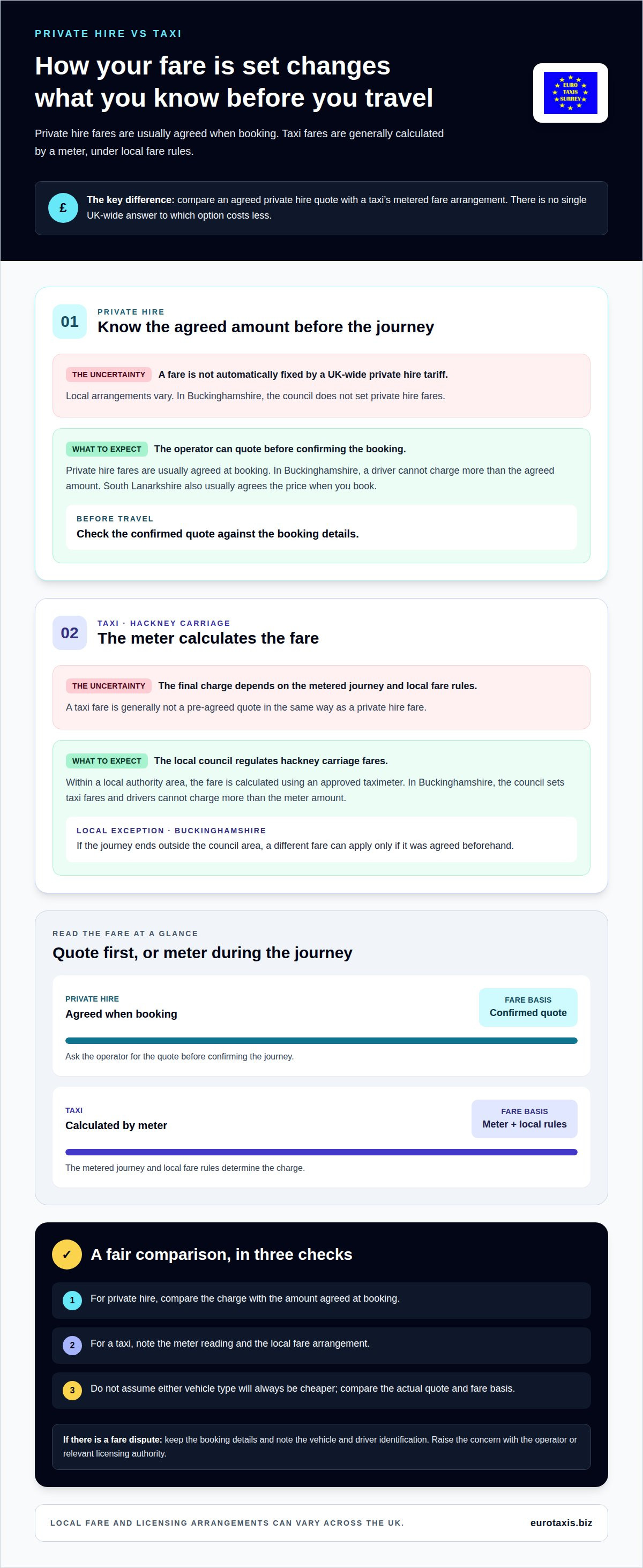
In the UK, private hire fares are usually agreed at booking. The operator can provide a quote before confirming the journey. In Buckinghamshire, the council doesn’t set private hire fares, and a driver can’t charge more than the agreed amount. South Lanarkshire also usually agrees the price when you book.
In a private hire versus taxi comparison, the key difference is when the fare is set. A private hire quote gives you an agreed amount before travel. A taxi fare is generally calculated by meter, so the final charge depends on the metered journey and local fare rules.
Within a local authority area, hackney carriage fares are regulated by the council and calculated using an approved taximeter. In Buckinghamshire, the council sets taxi fares. Drivers can’t charge more than the meter amount unless the journey ends outside the council area and the fare was agreed beforehand.
There’s no single UK-wide answer to which option costs less. To compare private hire and taxi fares, look at the confirmed private hire quote alongside the taxi’s metered fare arrangement, rather than assuming one type will always be cheaper.
Vehicle identification can help you tell which fare system applies. In Buckinghamshire, a taxi has a roof sign, a rear licence plate and a windscreen card. Its blue-and-white plate and card display licence details. Private hire vehicles have different markings, so identify the vehicle before starting a booked journey.
For an arranged journey, book a private hire journey with the pickup and destination details ready. That gives the operator the information needed to provide a fare before travel.
How to identify taxis and private hire vehicles
Vehicle markings vary between councils, so check the local licence details rather than relying on colour alone. In Buckinghamshire, a standard private hire vehicle has a rear licence plate, a windscreen card and signs on both front doors. Its yellow plates and signs show the licence number, vehicle details and licence expiry date.
Executive private hire vehicles in Buckinghamshire can look different. They are used for corporate contract work, with journeys pre-booked through a licensed operator using an account or contract. An executive vehicle may have a smaller, gold-coloured number plate, without a windscreen disc or door stickers. A smartly dressed driver and high-specification vehicle may also distinguish it.
Vehicle checks and passenger insurance are part of safe licensed operation. In South Lanarkshire, vehicles must pass regular inspections every year. Vehicles over 5 years old must pass inspections every 6 months. These inspections apply to the vehicle, not just its appearance, so a visible licence plate alone does not show its inspection history.
All vehicles in South Lanarkshire must be insured to carry passengers. A private hire driver who accepts a passenger without a booking may not be insured. This is why the vehicle category matters: a private hire car operates on pre-arranged journeys, while a taxi can also pick up passengers through permitted street or rank hiring.
Before travelling, match the vehicle’s visible licence information to the type of journey you arranged. For example, a Buckinghamshire executive car may not display the usual windscreen card or door signs, so its gold-coloured plate and pre-arranged corporate booking provide useful context. Vehicle choice also depends on the journey: an executive contract trip differs from an ordinary private hire booking. Local markings and operating conditions mean appearance alone may not identify a vehicle’s category.
Taxi bookings, ranks and flagging down
A taxi offers several ways to start a journey. In Buckinghamshire, you can book one in advance, hail it on the street or board at a taxi rank. St Helens and South Lanarkshire also allow hackney carriages to accept rank and street-hail fares. This flexibility can help when plans change or you need a vehicle without booking ahead.
Private hire works differently. You must book every journey through a licensed private hire operator before getting in. The operator takes the booking, assigns a driver and records the journey. Depending on the operator, you can book by phone, app or website. A private hire driver cannot legally stop to accept a fare from someone waving them down.
Advance booking gives the operator the pickup point, destination and journey details before a driver is assigned. A private hire car also cannot wait at a taxi rank or accept a walk-up fare there. In St Helens, accepting a fare without a prior booking is highly likely to invalidate the vehicle’s motor insurance. A pre-arranged pickup therefore matters both for the booking and for the vehicle’s permitted work.
Can private hire vehicles use taxi ranks or bus lanes in the UK? They cannot wait at taxi ranks, which councils designate for licensed hackney carriages. Bus-lane access depends on the restrictions for that lane, so don’t assume a vehicle can use one simply because it is licensed.
For planned travel, make the booking through the operator and provide accurate journey details. A taxi can also be pre-booked, but its rank and street-hail options remain useful when you need to travel without an arrangement. For a journey that needs advance coordination, book a private hire journey with the pickup and destination details ready.
Euro Taxis: Private Hire Services
Euro Taxis provides private hire services for journeys arranged in advance. This suits planned travel when you can organise the pickup and destination before setting off, rather than relying on a street hail or taxi rank.
For regular business travel, Account Work helps organise journeys through an account. Airport Transfers suit travel involving a flight, while Hospital/Medicals Runs can support trips to appointments. These services help match the booking to the reason for travel.
When making an enquiry, share your pickup point, destination and journey details. For an appointment or airport trip, include the relevant timing so the journey can be arranged around your plans.
Contact Euro Taxis to discuss a private hire journey that suits your travel needs.
Plan your next journey with confidence
A private hire versus taxi decision is most useful when you start with the journey you need to make. Consider your pickup point, destination, timing and any practical requirements for passengers. Having these details ready gives you a clear basis for arranging suitable transport.
For regular travel, consider how bookings can fit your routine. For a one-off trip, focus on the journey and the arrangements that will make it straightforward. Sharing relevant details early helps keep planning clear, especially when travelling to an appointment or flight.
Euro Taxis can help you arrange private hire travel around your plans. Contact Euro Taxis today to discuss your journey and take the next step towards a well-organised trip.
Frequently Asked Questions
What’s the Difference Between a Taxi and a Hackney Carriage?
In everyday UK usage, “taxi” and “hackney carriage” are often used to describe the same kind of vehicle. A local authority licenses hackney carriages to carry passengers, including people who hire them at ranks or hail them in the street. “Taxi” is more familiar in everyday conversation, while “hackney carriage” is common in licensing information.
What is the difference between a private hire vehicle and a taxi in the UK?
The main difference is how passengers can arrange a journey. A taxi, or hackney carriage, can take passengers who hail it or board at a rank. A private hire vehicle must be booked before the passenger gets in. For example, a car waiting outside a venue isn’t available for a walk-up private hire fare unless that journey has been booked.
Can you hail a private hire car on the street, or must it be pre-booked?
You must book a private hire car through a licensed operator. You can’t legally hail one in the street, even if it looks unoccupied or resembles a taxi. Arrange the journey with the operator before boarding, and make sure the pickup details match your booking. If you need to hail a vehicle without booking first, use a licensed taxi instead.
What licensing rules apply to taxi and private hire drivers, vehicles and operators?
Outside London, local authorities oversee taxi and private hire licensing; in London, Transport for London regulates both categories. Private hire operators and drivers need separate licences, and vehicles must also be licensed for the relevant work. Driver assessments can include identity, medical and background checks. Requirements vary by licensing area, so a licence in one council area doesn’t mean every local rule is the same.
How can you identify a licensed taxi or private hire vehicle?
Check the vehicle’s licence plate, display card and local identification markings, then compare them with the vehicle arriving for your journey. Markings differ by council, so a colour or roof sign alone isn’t a reliable guide across the UK. For a pre-booked private hire car, use your booking details to identify the assigned vehicle before getting in.
How do you book a private hire car or find a licensed taxi?
Arrange private hire through a licensed operator, using its available phone, app or website channel. To find a taxi without booking ahead, use a designated rank or hail one where permitted. For planned journeys around Camberley and Farnborough, Euro Taxis provides private hire bookings. Share your pickup point and destination clearly so your journey can be organised.


