

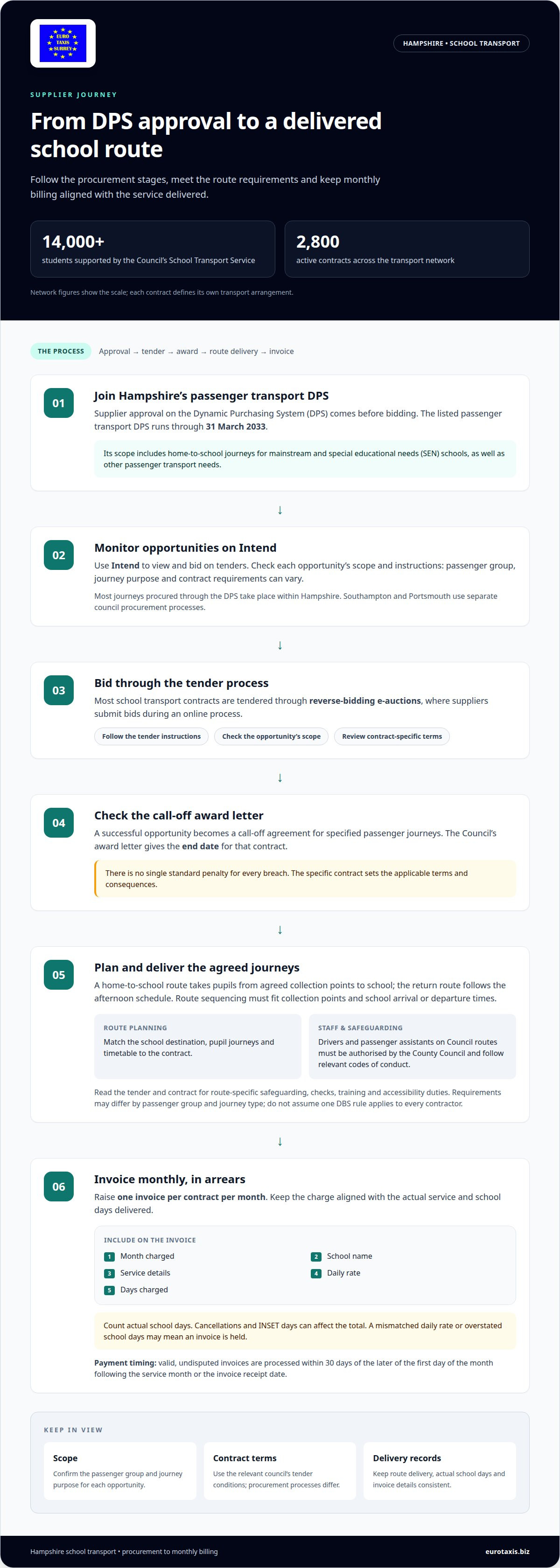
Getting onto the tender list comes before bidding. To pursue school transport contracts in Hampshire, suppliers must be approved on Hampshire County Council’s passenger transport Dynamic Purchasing System (DPS) and use Intend to view and bid on tenders. Most contracts are awarded through reverse-bidding e-auctions, and the listed DPS runs through 31 March 2033.
It’s understandable to want a clear picture of how regular school journeys are organised, what supplier approval involves and where club transport fits. The practical details matter: routes must work around school schedules, and tender requirements determine how operators can take part.
This guide explains daily home-to-school and school-to-home routes, Hampshire County Council’s tender process, and the approval and safeguarding considerations for transport suppliers. It also explains how club journeys fit alongside school travel, helping you identify which arrangements apply to your needs.
Key Takeaways
- Understand how daily school journeys are arranged and what the Council’s active contract network means for route planning.
- See the steps suppliers need to take to access tenders, including the role of Intend, the Dynamic Purchasing System and reverse-bidding e-auctions.
- Learn how authorisation, DBS checks and codes of conduct shape safeguarding, and which contract details affect delivery and invoicing.
- For recurring business journeys, Euro Taxis’ Account Work provides a practical transport option alongside its hospital and medical runs and business travel.
Daily home-to-school and school-to-home routes
A home-to-school route takes pupils from agreed collection points to their school. A school-to-home route carries them back after the school day. Hampshire County Council’s School Transport Service supports daily travel for more than 14,000 students through 2,800 active contracts. These figures show the scale of the network, while each contract sets out a particular transport arrangement.
Route planning matches pupil journeys to the school destination and timetable. For example, a morning route may collect pupils at separate points before travelling to one school. The return journey follows the afternoon schedule. When a route serves several pupils, its planned sequence must account for their collection points and the school’s arrival and departure times.
Hampshire County Council’s passenger transport arrangements cover mainstream and special educational needs (SEN) schools. Mainstream transport serves pupils attending ordinary school settings; SEN transport serves pupils attending special educational needs schools. The Council’s passenger transport DPS includes home-to-school travel for both. This distinction matters when a contract specifies the school and transport service required.
Drivers and passenger assistants on Council school routes must be authorised by Hampshire County Council and follow the relevant codes of conduct. Delivering a route involves more than reaching each stop: the assigned staff must meet the Council’s authorisation requirements and conduct expectations. The contract award letter also gives the end date for each call-off contract, defining the term of that route arrangement.
Accurate records help keep route delivery and monthly billing aligned. Hampshire County Council transport invoices should be raised in arrears, with one invoice per contract per month. Include the month charged, school name, service details, daily rate and days charged. Count actual school days: cancellations and INSET days can affect the total. Valid, undisputed invoices are processed within 30 days of the later of the first day of the month following the service month or the invoice receipt date. The Council may hold invoices with a mismatched daily rate or overstated school days.
Hampshire County Council school transport contract
Hampshire County Council procures passenger transport through an approved supplier system and individual contract opportunities. Southampton and Portsmouth use separate council procurement processes, so Hampshire’s arrangements should not be assumed to apply there.
Hampshire contract overview
A Hampshire school transport contract is a call-off agreement for specified passenger journeys. Suppliers must join the Dynamic Purchasing System (DPS) and use Intend to view and bid on tenders. The passenger transport DPS includes home-to-school journeys for mainstream and special educational needs schools. Most journeys procured through it take place within Hampshire.
The listed DPS runs through 31 March 2033. Most school transport contracts are tendered through reverse-bidding e-auctions, where suppliers submit bids during an online process. Hampshire County Council issues an award letter for each call-off contract; that letter gives the contract end date. A passenger transport DPS award notice, 2026/S 000-100419, was published on 23 October 2026.
For suppliers, the practical sequence is to obtain DPS approval, monitor Intend, and follow the tender instructions for each opportunity. The DPS also covers wider passenger transport needs, including adult and children’s social care, community transport, taxi-shares and car-shares. Read each opportunity’s scope carefully: a contract may cover a different passenger group or journey purpose.
Failure risks and penalties
Failure risks are the service or contractual consequences of not meeting an agreed requirement. On Hampshire routes, drivers and passenger assistants must be authorised by the County Council and follow the relevant codes of conduct. Suppliers should ensure assigned staff and daily operations meet the contract requirements.
There is no standard penalty amount or single sanction for every breach across Hampshire contracts. The specific contract sets the applicable terms, so a missed requirement may have consequences defined by that agreement. Do not assume the same outcome applies to every route or call-off.
How do the risks compare with Southampton and Portsmouth? Each council procures separately, so Hampshire’s DPS process and contract terms are not a reliable guide to the other authorities’ requirements. For any bid, use the relevant council’s tender conditions to understand its process and contractual consequences.
What safeguarding, DBS, training and accessibility rules apply to school transport contractors in Hampshire?
Safeguarding means protecting passengers from harm during transport. For a Hampshire contract, read the tender and contract documents to identify the duties that apply to the specific route. Requirements can differ by passenger group and journey type. A mainstream school journey and a route serving a special educational needs school may involve different practical arrangements.
A Disclosure and Barring Service (DBS) check helps employers assess a candidate’s suitability for certain roles. Successful candidates for Hampshire County Council’s Compliance and Schools Liaison Officer role are subject to DBS checks and other relevant employment checks. This recruitment detail does not establish a universal DBS rule for every transport contractor. Use the tender terms to identify the checks required for the contract.
Training helps staff carry out their assigned duties consistently. Build a route-specific induction around the contract: cover the passenger handover process, route plan and response to unexpected changes. Give drivers and passenger assistants clear instructions, and ensure everyone understands their responsibilities before starting the route.
Accessibility means planning transport around passengers’ mobility and support needs. Hampshire’s passenger transport DPS includes journeys for mainstream and special educational needs schools. An earlier contract described individual passenger transport in vehicles with 16 seats or fewer, for the period from 1 December 2020 to 28 February 2021. That historical example is not a current universal vehicle rule.
For a practical tender review, organise requirements into checks, staff preparation and vehicle suitability. First, identify each passenger group and the journey duties in the specification. Then match staff training and route procedures to those duties. Finally, ensure the proposed vehicle arrangement suits the stated passenger needs. This helps operators respond to the actual contract rather than assume one arrangement covers every Hampshire route.
What insurance, compliance and performance standards must contractors meet?
Insurance requirements are the cover conditions stated in a specific tender or contract. For a Hampshire school route, read the insurance schedule alongside the service specification. Note the policy types, required limits, evidence format and renewal conditions. These details can differ between opportunities, so do not assume one contract’s schedule applies to another.
Compliance means meeting the duties and documentation required for the awarded service. Compare the tender requirements with the proposed operation: vehicle arrangements, assigned staff, route instructions and reporting procedures. For example, if the contract requires service-delivery records, decide who will maintain them and how they will be available for review. Keep the signed contract and relevant schedules accessible to the people managing the route.
Performance standards describe how the authority assesses delivery against the contract. Check the tender documents for stated measures, such as punctuality, completed journeys, accurate records or incident reporting. Assign responsibility for each measure. If a route changes, record the agreed instruction and communicate it to the staff responsible for that journey.
Hampshire County Council’s invoice rules make accurate service records important. Transport invoices are raised in arrears, with one invoice per contract per month. Each invoice must identify the month, school, service, daily rate and days charged. A rate that differs from the Council’s recorded rate, or an incorrect count of school days, may put an invoice on hold. Cancellations and INSET days affect the days charged.
Before submitting a bid, prepare a contract-readiness review: match each insurance condition to its evidence, each compliance duty to an owner, and each performance measure to a record. During delivery, keep route changes and service records together. This gives the contract manager a clear way to compare agreed requirements with actual journeys, invoices and supporting documents.
Euro Taxis: Account Work
Euro Taxis offers Account Work for organisations arranging transport outside a Hampshire County Council school contract. If your requirement is regular business journeys rather than a tendered pupil route, this may be the more relevant option. Euro Taxis also provides Business Travel and Hospital/Medicals Runs for work-related journeys and travel to medical appointments. These services are separate from emergency or ambulance transport.
For example, an organisation coordinating business journeys can enquire about Account Work, while an individual trip to a work meeting may suit Business Travel. The right service depends on the journey’s purpose and the arrangement needed. These options support transport needs beyond council school contracts without confusing private arrangements with council procurement.
Contact Euro Taxis to discuss Account Work or another suitable journey.
Plan your next transport arrangement
Decide whether your next step is to pursue a council tender or arrange transport for a separate need. Operators considering school transport contracts in Hampshire, particularly around Camberley and Farnborough, should focus on the relevant opportunity and its requirements. For organisations arranging other journeys, a direct transport enquiry may be a better fit.
Euro Taxis provides local school contracts and Account Work across Camberley and Farnborough, alongside Hospital/Medicals Runs and Airport Transfers. These services support different journey needs, from school travel arrangements to medical appointments and airport journeys. When getting in touch, describe the journey purpose and arrangement you need so the discussion can focus on a suitable option.
Contact Euro Taxis about school transport to discuss your requirements. A clear next step can make your transport planning more straightforward.
Frequently Asked Questions
What school transport contracts are available in Hampshire?
Hampshire’s passenger transport opportunities include mainstream and special educational needs school journeys, alongside community transport contracts that include school services. Five Connect services with school transport are Basingstoke, Eastleigh, Fareham, Havant and Winchester. Opportunities arise through individual procurement exercises, so the contract type and route depend on each published call-off, not a single county-wide arrangement.
Which Hampshire County Council tenders cover school transport and home-to-school transport?
Hampshire County Council’s passenger transport Dynamic Purchasing System covers home-to-school journeys for mainstream and special educational needs schools. Its wider scope includes adult and children’s social care transport, community transport, taxi-shares and car-shares. A tender under the system may therefore cover school travel or another passenger group. Read the specific opportunity’s scope to identify the journeys included.
Where can suppliers find and bid for Hampshire school transport contracts?
Suppliers need approval on Hampshire County Council’s passenger transport Dynamic Purchasing System before accessing tenders through Intend. After approval, use Intend to find relevant opportunities and follow the instructions for each bid. Most school transport contracts use reverse-bidding e-auctions. Keep the tender documents available, as each opportunity sets out its own submission requirements and timetable.
What are the eligibility and vehicle requirements for Hampshire school transport providers?
Suppliers must be approved on the Council’s Dynamic Purchasing System to view and bid for its tenders. Drivers and passenger assistants assigned to Council school routes must be authorised by Hampshire County Council and follow its relevant codes of conduct. Vehicle suitability depends on the particular tender specification. A past contract described individual passenger transport in vehicles with 16 seats or fewer, from 1 December 2020 to 28 February 2021.
What is the tendering process and typical contract duration for Hampshire school transport?
The process starts with supplier approval on the Dynamic Purchasing System, followed by finding an opportunity on Intend and submitting a bid as directed. Most school transport opportunities are awarded through reverse-bidding e-auctions. Each call-off sets its own contract duration rather than following one fixed term for every route. Hampshire County Council’s award letter gives the end date for that specific contract.
Which areas, schools and passenger groups are covered by Hampshire school transport routes?
Most journeys procured through Hampshire County Council’s passenger transport system take place within Hampshire. School journeys cover mainstream and special educational needs schools. The wider system also covers adult and children’s social care, community transport, taxi-shares and car-shares. School transport is included in five Connect services: Basingstoke, Eastleigh, Fareham, Havant and Winchester.


